Wim Hof Method · Cold Exposure · Breathwork
The Wim Hof Method
Cold and the breath. Three pillars — breath, cold, mind — that give back to modern humans what millennia of comfort have slowly taken away: the ability to regulate the body from within.
The Breathing Exercise
The breathing component is the core of the Wim Hof Method. It consists of rapid, full inhalations followed by passive exhalations — 30 to 40 cycles — then a breath retention (holding out) followed by a recovery inhalation held briefly. The cycle is typically repeated 3 to 4 rounds. Wim Hof describes it as 'getting high on your own supply.' The physiological effects are immediate and measurable.
- Find a comfortable position — lying down or seated. Make sure you are safe and not about to drive or operate machinery. NEVER practise in water.
- Take 30 to 40 full, powerful breaths. Inhale completely through the nose or mouth — belly first, then chest, fully. Exhale passively, without force — just let go. Do not pause between breaths. The rhythm is continuous.
- On the final exhale of the round, let all the air out and stop breathing. Hold the breath out (Bahya Kumbhaka). Do not force this — simply wait. Stay relaxed. Your body has more oxygen than it needs right now.
- Hold out for as long as feels comfortable. When the genuine urge to breathe returns (not the first impulse — the real one), take a deep recovery breath in.
- Hold this recovery breath for 10 to 15 seconds, then release.
- This completes one round. Rest for a moment. Observe how you feel. Then repeat. Typically 3 to 4 rounds.
- After all rounds, rest in the state. Many practitioners describe this as a 'charged' feeling — tingling, spacious, energised without stimulants.
The rapid breathing sharply reduces blood CO₂ (hypocapnia), which shifts the blood pH toward alkalinity. This alkaline shift causes temporary vasoconstriction, producing the characteristic tingling and lightheadedness. Paradoxically, the body actually has more oxygen — but haemoglobin releases it less efficiently in alkaline conditions (the Bohr effect). During the breath retention that follows, CO₂ rises again, the blood re-acidifies, and haemoglobin releases its oxygen. The net effect: a highly oxygenated state in the retention phase, with elevated adrenaline, and a measurable reduction in pro-inflammatory cytokines. A 2014 study at Radboud University Medical Center demonstrated that WHM-trained practitioners could consciously suppress the immune response to endotoxin injections — the first scientific evidence that humans can voluntarily influence the innate immune system.
"The breath is the steering wheel of the body. When you learn to control the breath, you learn to control your whole being."
| Aspect | WHM | Classical Pranayama |
|---|---|---|
| Primary technique | Controlled hyperventilation + breath hold | Alternate nostril / slow deep breathing |
| Effect direction | Activating — sympathetic dominant | Calming — parasympathetic dominant |
| CO₂ direction | Drops rapidly (hypocapnia) | Rises gradually (Kumbhaka) |
| Adrenaline | Elevated during practice | Lowered during practice |
| Heart rate | Elevated, then drops sharply | Gradually lowered |
| Tradition | Developed post-1980s, informed by Tummo | 3000+ years of documented practice |
| Evidence base | RCTs, immune studies, neuroimaging | Growing clinical evidence, EEG, HRV studies |
| Best time | Morning, on empty stomach | Morning or evening, on empty stomach |
| Analog pranayama | Closest to Bhastrika | Bhastrika — the bellows breath |
The breathing and cold tolerance aspects of WHM bear a close resemblance to Tibetan Tummo (Inner Fire) meditation — a Vajrayana practice used by monks to dry wet sheets on their bodies in sub-zero temperatures as a demonstration of heat generation. Both involve specific breathing patterns combined with mental imagery and cold exposure. Wim Hof acknowledges this lineage while noting that his development was experiential rather than received from a tradition. Tummo is part of the Six Yogas of Naropa; WHM is available on an app. Different paths to overlapping territory.
Never do the WHM breathing exercise in or near water — the combination of hypocapnia and relaxation has caused drowning deaths. Never practise while driving or in any situation where losing consciousness would be dangerous. The tingling, lightheadedness, and muscle tetany (cramping hands) during the breathing are normal and expected — they arise from CO₂ reduction and pass quickly. If you faint, you will automatically begin breathing again. This is not dangerous in a safe, horizontal position. It is potentially fatal in water. Source: Wim Hof Method, Wim Hof (Sounds True, 2020).
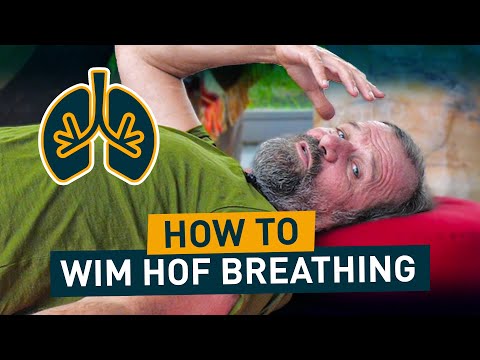
Start with the tutorial to understand the method, then follow a guided session. Never practice in or near water, or while driving.